Short-Term vs. Long-Term Rentals: Which Is More Profitable in Jacksonville?

If you own a rental property in Jacksonville, one of the biggest decisions you will make is how you want to rent it out.
A long-term lease can give you the security of predictable monthly income, but a short-term rental can potentially earn higher revenue, especially if your property is in a tourism-heavy area.
So which is more profitable in Jacksonville in 2026: short-term or long-term rentals?
The answer depends on your specific property, its location, the type of renter it attracts, and your overall investment goals.
Jacksonville's Current Rental Market in 2026
Jacksonville continues to have a large and diverse rental market, but current conditions make it especially important for property owners to price and position their rentals carefully.
According toZillow's current Jacksonville rental market data, the average rent across all bedrooms and property types is $1,600 per month as of August 2026. That's down $50 from the previous year, and Zillow currently classifies Jacksonville's rental market as "cool" based on renter demand compared with the national average.
That citywide number doesn't tell us much about what a particular luxury home can earn, though.
A waterfront property in Ponte Vedra Beach, a furnished home near Jacksonville Beach, and a three-bedroom house in a suburban neighborhood are all competing for different types of renters. Location, property size, amenities, condition, and demand within the specific neighborhood can have a much bigger impact on rental income than the citywide average.
That is whyunderstanding how to accurately price a Jacksonville rental is an important first step before deciding which rental strategy makes the most sense.
What Is the Difference Between a Short-Term and Long-Term Rental?
The basic difference is the length of the tenancy, but the financial and operational differences go much further.
Long-Term Rentals
Long-term rentals are typically leased for several months to a year or longer.
The owner generally collects a set monthly rent from one tenant under the terms of a lease. The tenant is responsible for living in the property during the lease term, and many of the property's routine operating costs may be lower than they would be with a furnished short-term rental.
The biggest benefit is predictability.
Once a qualified tenant is in place, the owner doesn't have to worry about finding a new guest every few days or weeks. There is also less turnover, less cleaning, and less frequent communication.
For investors who prioritize stable cash flow and a relatively straightforward ownership experience, long-term rentals can be a great option.
Short-Term Rentals
Short-term rentals are rented for much shorter stays, often vacations, through platforms such as Airbnb, Vrbo, or Booking.com.
Instead of collecting one monthly rent payment, owners generate revenue based on nightly or weekly bookings.
That gives owners more flexibility with pricing, but it also means revenue can fluctuate significantly.
A short-term rental may perform exceptionally well during a busy season and much less well during slower periods. The owner also takes on additional expenses and responsibilities associated with operating a furnished property.
Those expenses can include:
Cleaning between guests
Utilities
Internet
Furnishings
Linens and supplies
Guest communication
Maintenance
Increased wear and tear
Platform fees
Marketing
Dynamic pricing
Local and state taxes and requirements
The result is a rental strategy with a higher potential revenue ceiling, but also more moving parts.
How Much Can a Jacksonville Short-Term Rental Make?
Jacksonville has a substantial short-term rental market, but the numbers need to be interpreted carefully.
According toAirDNA's Jacksonville short-term rental market data, Jacksonville had 4,835 active short-term rental listings as of July 2026. Those listings averaged 56% occupancy and a $132 average daily rate, with average annual revenue of approximately $15,200.
AirDNA also reports that annual revenue per active listing increased 30.6% year over year, while average daily rates decreased 9.8% over the same period.
Those figures show that there is real demand for short-term rentals in Jacksonville, but you can't always copy and paste results from one property onto your specific situation.
A luxury beach property with a pool and multiple bedrooms may perform very differently from a smaller inland property.
The same is true for occupancy. A 56% average occupancy rate does not mean every property will be occupied 56% of the time.
For an owner thinking about a short-term rental, the relevant question isn't:
"How much does the average Jacksonville Airbnb make?"
The right question is:
"What could this specific property realistically earn, and what would it cost to operate?"
Why Short-Term Rentals Can Be More Profitable
With a short-term rental, you can adjust the nightly rate based on demand.
That can be extremely valuable in coastal areas like Neptune Beach and Ponte Vedra that attract more tourism.
A property near the beach, for example, may command higher rates during periods of strong demand. Owners can potentially increase prices when demand rises and lower them during slower periods to encourage bookings.
Short-term rentals can also benefit from properties that offer something difficult to replicate in a traditional rental.
A luxury home with a pool, outdoor entertaining space, high-end furnishings, multiple bedrooms, or a desirable location may attract visitors looking for an experience rather than simply a place to live.
For the right property, that can create increase gross rental revenue more than a traditional lease.
When Long-Term Rentals Can Be More Profitable
The opposite can also be true. (This is why it's so important to work with a local expert one-on-one.)
A long-term rental may produce less gross revenue but more predictable net income.
Here's a hypothetical example to explain this better:
A long-term tenant pays $4,000 per month, producing $48,000 in annual gross rent.
A short-term rental generates an average of $6,000 per month in bookings, producing $72,000 in annual gross revenue.
At first glance, the short-term rental appears to be the clear winner.
But imagine the short-term property also requires:
$4,000 in annual utilities
$6,000 in cleaning
$3,000 in supplies and furnishings
Higher maintenance costs
Platform fees
Additional management costs
More frequent vacancy between bookings
The difference between $72,000 and $48,000 becomes much smaller once the actual operating expenses are included.
That is why investors should compare net income rather than gross rental revenue.
The Management Difference Is Significant
There's another consideration that's easy to overlook: your time.
A long-term rental may require marketing the property, screening tenants, coordinating maintenance, collecting rent, handling lease renewals, and dealing with tenant issues.
A short-term rental can require all of that plus:
Responding to guest inquiries
Managing reservations
Coordinating check-ins and check-outs
Scheduling cleaners
Replacing supplies
Handling guest complaints
Managing reviews
Adjusting nightly prices
Responding to maintenance problems between stays
If you're managing one property yourself, that may be manageable. But if you own several properties, the workload can increase quickly.
This is one reasonthe decision to hire a property manager for a luxury rental should be considered alongside the rental strategy itself.
What About Luxury Jacksonville Rentals?
Luxury properties require a slightly different analysis.
A high-end property may have significantly more short-term rental potential than the average Jacksonville home, especially if it has features that travelers actively seek.
Examples include:
Waterfront or beach access
Private pools
Large outdoor living spaces
High-end kitchens
Multiple bedrooms and bathrooms
Designer furnishings
Golf or country club access
Proximity to restaurants and entertainment
Premium neighborhood locations
These features can support higher nightly rates.
But luxury properties also come with higher expectations.
Guests paying a premium expect the home to be exceptionally clean, well maintained, fully stocked, and professionally presented. Furniture, appliances, landscaping, pools, and other amenities need to remain in excellent condition.
For that reason, luxury property owners shouldn't make a decision based solely on the highest possible nightly rate.
The better question is whether the property's net income after all expenses justifies the additional work and risk.
Jacksonville Location Can Change the Equation
There isn't one rental strategy that works equally well across Jacksonville.
A coastal property in Jacksonville Beach or Atlantic Beach may have a different short-term rental profile than a home in a neighborhood primarily serving local families.
A luxury property in Ponte Vedra may attract a different renter altogether, including relocating professionals, executives, families, or seasonal residents.
The surrounding neighborhood, proximity to the beach, local amenities, property type, and restrictions on short-term rentals all need to be considered.
For investors evaluating higher-end areas,comparing Jacksonville's best neighborhoods for rental property investment can help put the differences between local markets into context.
Don't Overlook Short-Term Rental Regulations
Profitability isn't the only consideration when evaluating a short-term rental.
Jacksonville short-term rental owners need to understand the applicable state and local requirements before listing a property.
According to theCity of Jacksonville's short-term rental requirements, owners may need to register with the Florida Department of Business and Professional Regulation and the Duval County Tax Collector, obtain required fire inspections, post required signage, and comply with applicable land-use, zoning, parking, and noise requirements.
The city also notes that using a booking platform such as Airbnb, Booking.com, or Vrbo does not necessarily mean all required taxes are being handled on the owner's behalf.
This is particularly important for investors purchasing a property specifically for short-term rental use.
Before assuming a property will generate a certain level of income, confirm that the intended rental strategy is permitted and understand any applicable restrictions, including those imposed by a homeowners association or condominium association.
Short-Term vs. Long-Term Rentals: Which Is Better?
Here's how the two strategies generally compare:
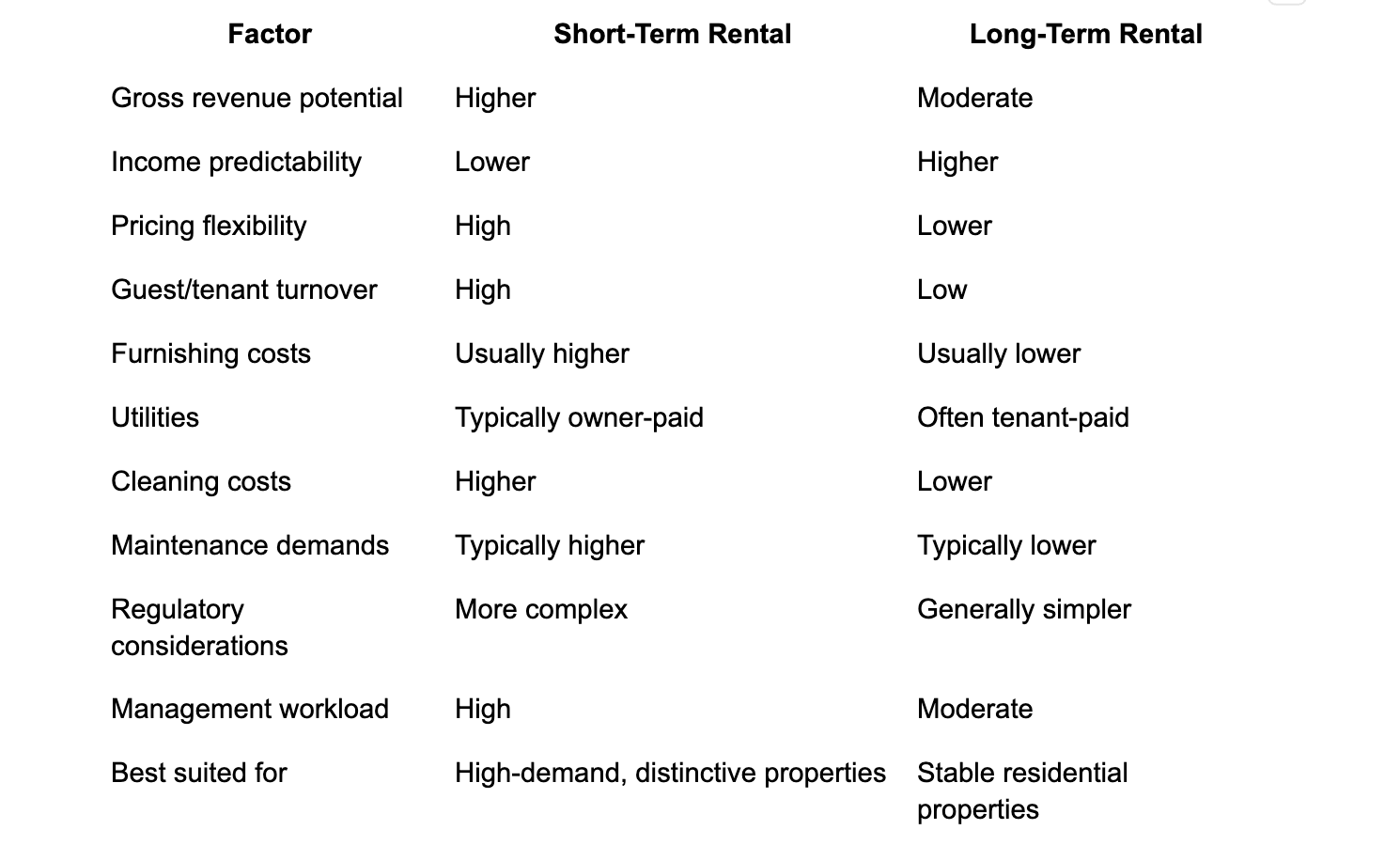
Neither option wins across every category.
A short-term rental can produce significantly more revenue, but it can also require substantially more work and operating capital.
A long-term rental can produce less revenue while offering greater consistency and fewer day-to-day responsibilities.
How to Compare the Two Strategies for Your Property
Before making a decision, run the numbers for both scenarios.
For a long-term rental, start with:
Monthly rent × 12 = annual gross rental income
Then subtract expected expenses such as:
Property management
Maintenance
Insurance
Property taxes
Vacancy
HOA fees
Landscaping
Other ownership costs
For a short-term rental, start with:
Average nightly rate × expected occupied nights = annual gross rental revenue
Then account for:
Cleaning
Utilities
Internet
Furnishings
Supplies
Platform fees
Management
Maintenance
Taxes
Vacancy
Marketing
Most importantly, use realistic occupancy assumptions.
A property that could theoretically rent for $300 per night doesn't generate $109,500 in annual revenue if it sits vacant much of the year.
Likewise, a $4,000-per-month long-term rental doesn't necessarily produce $48,000 in net income once ownership expenses are considered.
The goal is to determine which strategy produces the strongest return after expenses, not which one has the highest advertised rent.
Your Rental Strategy Can Change
Choosing a long-term or short-term rental strategy doesn't necessarily mean you're locked into that model forever.
Market conditions change. Your financial goals can change. The property itself can change.
A homeowner might operate a property as a short-term rental for several years and eventually transition to a long-term lease. Another owner might start with a long-term tenant and later decide that short-term rentals make more sense.
This flexibility can be particularly useful for owners who don't live in Jacksonville.
For example, an investor who lives in another state may initially plan to manage a Jacksonville property independently, only to realize that coordinating maintenance, tenants, and vendors from hundreds of miles away isn't practical.Managing a Florida rental property from out of state requires a different level of planning than managing a property locally.
So, Which Is More Profitable in Jacksonville?
There isn't a universal answer.
Short-term rentals may be the better option when:
The property is in a strong visitor or vacation market
The home has amenities that differentiate it
Local regulations permit short-term rentals
Expected nightly revenue justifies the additional expenses
The owner is comfortable with variable income
The property can be professionally managed
Long-term rentals may be the better option when:
Predictable monthly income is important
The property appeals strongly to local residents
The owner wants fewer turnovers
Operating costs need to remain relatively low
The property is in a primarily residential neighborhood
The owner prioritizes long-term investment stability
For luxury properties, the decision deserves even more scrutiny. A high nightly rate can look impressive on paper, but the best rental strategy is the one that produces strong net income while protecting the property and fitting the owner's goals.
The Bottom Line for Jacksonville Property Owners
Short-term rentals aren't automatically more profitable, and long-term rentals aren't automatically safer.
Jacksonville has opportunities for both.
The right choice depends on the property, location, expected demand, operating costs, regulations, and how involved you want to be in the day-to-day management.
Before deciding, compare realistic revenue projections for both strategies and account for every expense. A property that produces the highest gross revenue isn't necessarily the one that produces the best return.
For owners who aren't sure which strategy makes sense for a particular property, getting a property-specific rental analysis can be a useful place to start. The goal isn't simply to find the highest possible rent. It's to determine which approach makes the most sense for the property as an investment.
